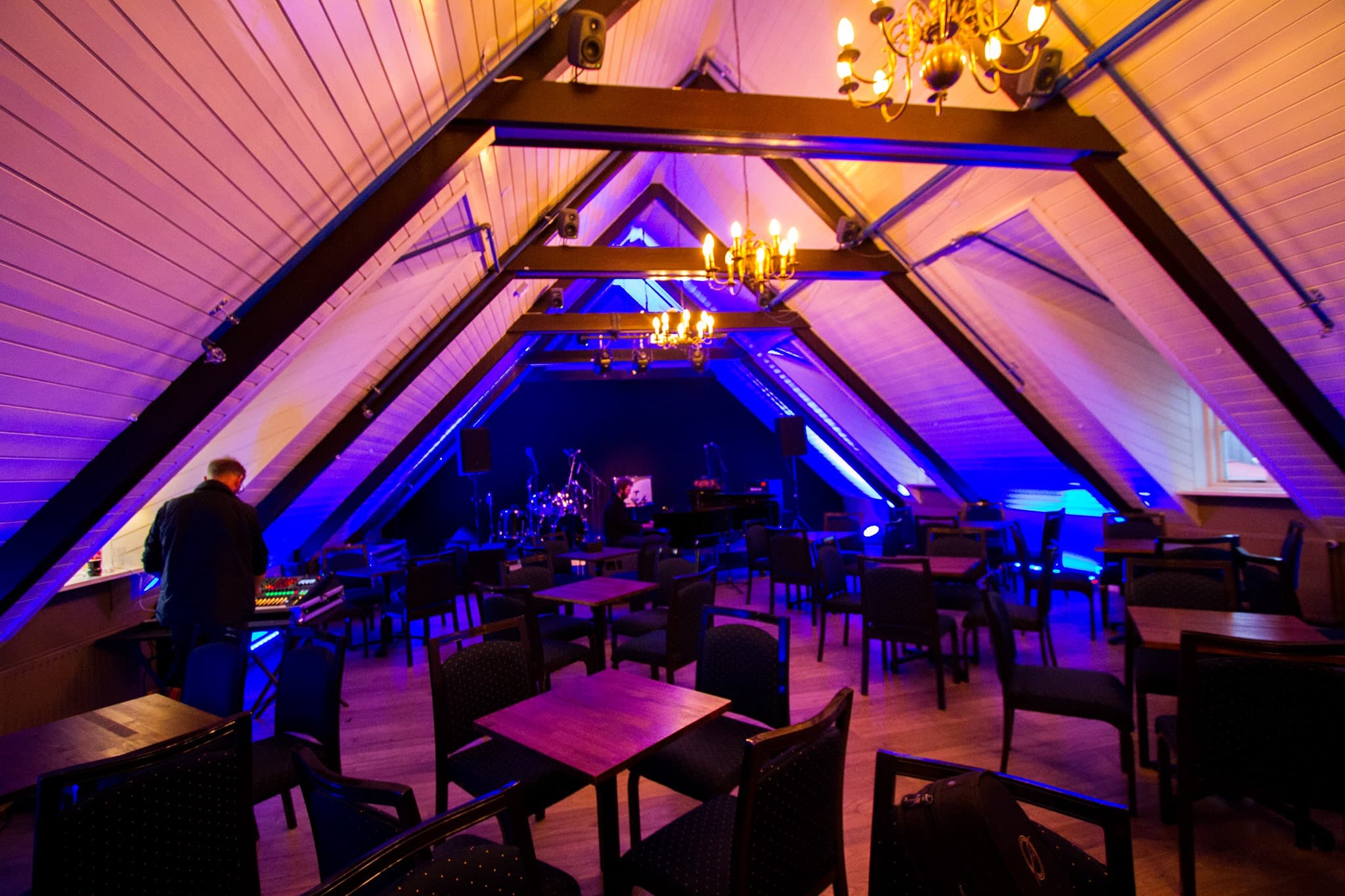
The building at Bankastræti 2 has been part of central Reykjavík for nearly two centuries. It opened as Iceland's first bakery in 1834, came close to demolition in the 1970s, returned as a restaurant in 1981, and today is the event venue Kornhlaðan. Here is the story of the building, as it appears to those of us running it now.
In 1834, the Danish ship-owner and merchant P. C. Knudtzon commissioned the building of a dwelling and a baking facility on this site. Iceland had no proper bakery yet, and Knudtzon meant to fill that gap. The following year, in 1835, the German-trained baker Tönnies Daniel Bernhöft arrived from Copenhagen to run it. Ten years later, in 1845, Bernhöft bought the residence and the bakery from Knudtzon, and the place took the name it would carry for almost a century: Bernhöftsbakarí — Bernhöft's Bakery.
For decades the bakery was a fixture of daily life downtown. Reykjavík was still a small town, and a single bakery could define a whole stretch of street. The slope at the corner of Bankastræti and Lækjargata was called Bakarabrekka — the bakery hill — for so long that the name outlived the bakery itself. It still lives in everyday speech, attached now to the small grass slope at that corner, where Ásmundur Sveinsson's Vatnsberinn (the Water Carrier) sculpture and the outdoor chess set by Jón Gunnar Árnason stand today.
The street itself was called Bakarabrekka until the bank arrived. On 1 July 1886, Landsbanki Íslands opened its doors at Bankastræti 3, and within a few years the street was renamed for it. Bakarabrekka faded from the map; Bankastræti took its place.
Bernhöftsbakarí stayed in operation until 1931, almost a hundred years after it began. The bakery closed, but the buildings — the dwelling, the bakery, and the storage rooms behind, the granaries from which the current name Kornhlaðan is drawn — remained.
In the 1970s the row of buildings, by then known collectively as Bernhöftstorfan, came close to disappearing. The Icelandic government planned to tear them down to make space for new government offices. A grass-roots preservation campaign formed under the association Torfusamtökin and pushed back. The dispute was loud, and it lasted years. Heritage protection was eventually granted in 1979, and a careful reconstruction of the row was completed in 1981.
That same year the restaurant Lækjarbrekka opened in the rebuilt building at Bankastræti 2. It served Icelandic cuisine here for more than thirty years.
Today the building is Kornhlaðan, an event venue operated by White Lotus ehf. and Blessing ehf. The room — 111 square metres under a pitched ceiling that rises to about five or six metres at its peak — seats 85 at a dinner and holds 150 at a standing reception. The name Kornhlaðan ("the grain loft") is drawn from the storage rooms of the original 1834 complex; the character of the place is drawn from everything that has happened on the site since.
When you walk in today, you walk into a room that was almost lost, was protected by public effort, was carefully restored, and has been put to use again. None of that needs saying out loud at an event. But it is good to know.